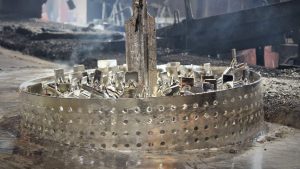

Hot-dip galvanizing coating thickness is one of the most critical parameters affecting the quality, durability, and service life of steel components. In the hot-dip galvanizing process, steel parts are coated with a protective layer of molten zinc to prevent corrosion, rust, and environmental degradation.
In many industrial sectors in Iran, including construction, oil and gas, petrochemical, power transmission, and agriculture, controlling the galvanizing coating thickness directly influences performance, maintenance costs, and even the final price of galvanizing services.
This article is written as a cluster article, supporting the pillar content “What Is Hot-Dip Galvanizing?”, and provides an in-depth technical review of coating thickness, international standards, influencing factors, measurement methods, pricing considerations, and service conditions in Iran.
What Is Hot-Dip Galvanizing
Hot-dip galvanizing is a type of metal plating process in which steel parts are cleaned, pickled, and then immersed in molten zinc at approximately 450°C.
This process forms a metallurgical bond between zinc and steel, resulting in a highly durable and corrosion-resistant coating.
Compared to cold galvanizing or paint coatings, hot-dip galvanizing provides superior protection and longer service life, especially in harsh environments.
Importance of Hot-Dip Galvanizing Coating Thickness
Coating thickness is not merely a numerical value; it is the primary indicator of galvanizing quality. A thicker and more uniform zinc layer offers:
- Higher corrosion resistance
- Longer service life
- Reduced maintenance and repair costs
- Better economic efficiency for industrial projects
Given Iran’s diverse climate conditions—from humid coastal regions to industrial and arid zones—selecting the appropriate galvanizing thickness is essential.
Definition of Galvanizing Coating Thickness
Hot-dip galvanizing coating thickness is typically measured in micrometers (µm).
- Every 100 µm of zinc thickness corresponds to approximately 720 g/m² of zinc coating.
Example:
70 µm ≈ 500 g/m² zinc coating
International Standards for Galvanizing Coating Thickness
ISO 1461 Standard
ISO 1461 is the most widely used international standard for hot-dip galvanizing.
Minimum Coating
| Steel Thickness
|
Thickness
|
| < 1.5 mm
1.5 – 3 mm
|
45 µm
55 µm
|
| 3 – 6 mm
|
70 µm
|
| > 6 mm
|
85 µm
|
ASTM A123 Standard
ASTM A123 is commonly applied in industrial and export-oriented projects in Iran.
Key features:
- Focus on average coating thickness
- Emphasis on coating uniformity
- Strict quality control requirements
Iranian Industrial Practice
Most galvanizing plants in Iran apply ISO and ASTM standards simultaneously, particularly in oil, gas, and infrastructure projects requiring high reliability.
Factors Affecting Hot-Dip Galvanizing Coating Thickness
Chemical Composition of Steel
The silicon (Si) and phosphorus (P) content of steel strongly affects the zinc–steel reaction.
- High silicon steel → thicker coating
- Controlled composition steel → more uniform coating
Steel Section Thickness
Thicker steel sections:
- React longer with molten zinc
- Absorb more zinc
- Produce thicker coatings
Immersion Time in Molten Zinc
Increasing immersion time:
- Increases coating thickness
- May cause rougher surface texture if excessive
Zinc Bath Temperature
The optimal zinc bath temperature ranges from 445 to 455°C.
Deviations can negatively affect coating quality and consistency.
Surface Preparation Quality
Proper degreasing, pickling, and fluxing result in:
- Improved zinc adhesion
- Uniform coating thickness
- Reduced zinc consumption and cost
Methods for Measuring Galvanizing Coating Thickness
Magnetic Thickness Gauge
The most common method used in Iranian galvanizing services:
- Non-destructive
- Fast and reliable
- Suitable for on-site inspection
Gravimetric (Weight) Method
Calculates zinc weight per surface area.
Mostly used in laboratories and standard compliance testing.
Microscopic Method
- Highly accurate
- Destructive
- Used for advanced quality control and research
Relationship Between Coating Thickness and Price
A frequently asked question in galvanizing services is:
Does a thicker coating mean a higher price?
Short answer: Yes—logically and economically.
Price-related factors include:
- Higher zinc consumption
- Longer processing time
- Stricter quality requirements
- Customized galvanizing services
For large-scale projects, selecting an optimal coating thickness can significantly reduce long-term costs.
Recommended Coating Thickness for Different Regions of Iran
Humid and Coastal Areas
- Recommended thickness: 70–85 µm
- High humidity accelerates corrosion
Industrial and Urban Areas
Recommended thickness: 60–70 µm
Air pollution increases corrosion risk
Dry and Desert Regions
Recommended thickness: 55–65 µm
Lower corrosion rates
Comparison: Hot-Dip Galvanizing vs. Cold Galvanizing (Plating)
| Feature
|
Hot-Dip Galvanizing
|
Cold Galvanizing
|
| Coating Thickness
|
High (55–85 µm)
|
Low (5–15 µm)
|
| Durability
|
Very high
|
Limited
|
| Price
|
Higher
|
Lower
|
| Application
|
Structural & industrial
|
Decorative & light-duty
|
Effect of Coating Thickness on Service Life
On average:
- Every 10 µm of zinc coating provides approximately 5–7 years of protection in urban environments.
Therefore, a 70 µm coating can offer up to 40 years of effective corrosion protection.
Hot-Dip Galvanizing Services in Iran and Thickness Control
Reputable galvanizing service providers in Iran offer:
- Certified thickness inspection reports
- Compliance with ISO and ASTM standards
- Custom coating thickness based on project needs
- Quality assurance and technical support
Choosing a reliable galvanizing service directly affects quality, durability, and price efficiency.
Common Misconceptions About Galvanizing Thickness
Thicker coating is always better
Thicker coating means smoother appearance
All steels receive the same zinc thickness
In reality, the balance between coating thickness, application, and price is the key to optimal performance.
Conclusion
Hot-dip galvanizing coating thickness is a fundamental parameter in steel plating and corrosion protection. It directly affects durability, service life, and the price of galvanizing services in Iran.
By selecting the appropriate thickness based on international standards, environmental conditions, and application requirements, industries can achieve long-term cost efficiency and structural reliability.